Extending MRBQ: development and preliminary psychometric evaluation of a multidimensional safety instrument for Malaysian school motorcyclists
Abstract
Motorcycle-related crashes remain a critical road safety concern in Malaysia, particularly among school motorcyclists who face behavioural and contextual risks during their daily travel. Although the Motorcycle Rider Behaviour Questionnaire (MRBQ) provides an established foundation for assessing riding behaviour, its behavioural focus may not adequately represent the broader safety conditions experienced by school motorcyclists. This study aimed to develop and preliminarily evaluate a context-specific, multidimensional instrument for measuring motorcycle safety performance among Malaysian school motorcyclists, using the MRBQ as the behavioural foundation. Instrument development integrated evidence from a systematic literature review and focus group discussions involving road safety professionals and school stakeholders. The resulting 43-item questionnaire comprised four domains: User Behaviour, Vehicle Condition, Road Safety Knowledge and Emergency Preparedness, and Physical Environment. Expert evaluation demonstrated excellent content validity (S-CVI = 0.97). Preliminary psychometric evaluation was conducted among 163 school motorcyclists using separate Rasch analyses for each domain. Person reliability ranged from 0.70–0.79 and item reliability from 0.70–0.95, while person and item separation ranged from 1.54–1.96 and 1.51–4.23, respectively. All items demonstrated positive Point-Measure Correlations, although several showed fit statistics requiring further evaluation. Wright maps also revealed differences in person-item targeting across domains. Overall, the findings provide preliminary evidence supporting the instrument’s content relevance and measurement performance while identifying areas for further refinement. The instrument extends the behavioural foundation of the MRBQ by incorporating broader motorcycle safety performance domains relevant to Malaysian school motorcyclists.
1. Introduction
Road traffic injuries remain one of the leading public health challenges worldwide, accounting for approximately 1.19 million deaths annually and ranking among the leading causes of mortality among children and young adults (WHO, 2023). Among all road users, motorcyclists are particularly vulnerable because of their limited physical protection and high exposure to traffic hazards. In Malaysia, motorcycles account for more than 60% of all registered vehicles and serve as a primary mode of transportation for many secondary school students, particularly in suburban and rural areas (Ministry of Transport Malaysia, 2024). Consequently, school motorcyclists represent a high-risk population requiring targeted road safety interventions. According to Sinar Harian (2024), 779 school students were killed in motorcycle-related crashes during the first nine months of 2024 alone, highlighting the urgent need for a better understanding of factors influencing motorcycle safety within this population.
Motorcycle safety is widely recognised as a multidimensional phenomenon influenced by the interaction of rider behaviour, vehicle condition, road environment, and road users' knowledge and awareness. Although engineering improvements, legislation, and enforcement remain fundamental components of road safety strategies, rider behaviour continues to be one of the strongest predictors of motorcycle crash involvement (Elliott et al., 2007; Malaysian Institute of Road Safety Research [MIROS], 2022; Stephens et al., 2017). Young motorcyclists are particularly susceptible to unsafe riding practices because of limited hazard perception, sensation seeking, peer influence, and developmental characteristics that affect riding decisions (O'Brien & Gormley, 2016; Siraj et al., 2021). At the same time, studies have demonstrated that vehicle roadworthiness, environmental conditions, and road safety knowledge also contribute substantially to crash risk (Haddon, 1980; WHO, 2018). Accordingly, contemporary road safety research increasingly advocates the use of Safety Performance Indicators (SPIs) to assess factors influencing road safety beyond crash outcomes alone (Elvik, 2009; Hutchinson, 2018; Wegman et al., 2008). In the present study, this perspective serves as the conceptual basis for extending the measurement scope of an existing behavioural instrument rather than proposing a new SPI framework.
The Motorcycle Rider Behaviour Questionnaire (MRBQ), developed by Elliott et al. (2007), is one of the most widely used self-report instruments for measuring motorcycle riding behaviour. Since its development, the MRBQ has been translated and adapted across various countries, including Iran, Hong Kong, Türkiye, Australia, Vietnam, Thailand, India, and Slovenia, consistently demonstrating acceptable psychometric properties (Cheng & Ng, 2010; Ferko et al., 2025; Motevalian et al., 2011). Despite these adaptations, the instrument has largely retained its original behavioural orientation, focusing on traffic errors, control errors, speed violations, stunts, and safety equipment use. While these behavioural constructs remain essential for understanding riding practices, they provide limited coverage of other factors that influence motorcycle safety among school motorcyclists (Kamaruddin et al., 2025).
This limitation highlights an important research gap. School motorcyclists operate within a unique context characterised by varying motorcycle conditions, differing levels of road safety knowledge and emergency preparedness, and diverse physical environments surrounding schools. Previous research has also highlighted the need for further refinement of the MRBQ when applied to novice riders (Sakashita et al., 2014). Nevertheless, previous MRBQ adaptation studies have primarily focused on cultural and linguistic adaptation while maintaining the original behavioural framework. Consequently, there remains a lack of a context-specific instrument capable of comprehensively assessing motorcycle safety performance among Malaysian school motorcyclists.
To address this gap, the present study systematically extends the behavioural foundation of the MRBQ to develop a multidimensional instrument for Malaysian school motorcyclists. The original behavioural constructs were adapted and contextualised, while additional domains were incorporated based on evidence from the literature and expert focus group discussions (FGD). The resulting instrument operationalises four motorcycle safety domains: User Behaviour, Vehicle Condition, Road Safety Knowledge and Emergency Preparedness, and Physical Environment, into measurable questionnaire items suitable for Malaysian school motorcyclists. Following instrument development, expert content validation and preliminary psychometric evaluation using the Rasch Measurement Model were conducted to establish initial evidence of the instrument's measurement properties. Accordingly, this study addresses the following research questions:
-
RQ1. How can the MRBQ be systematically extended to develop a multidimensional instrument for measuring motorcycle safety performance among Malaysian school motorcyclists?
-
RQ2. To what extent does the developed instrument demonstrate satisfactory preliminary psychometric properties based on expert content validation and Rasch Measurement Model analysis?
2. Literature review
Motorcycle safety remains a significant concern in road safety research, particularly in low- and middle-income countries where motorcycles are widely used because of their affordability and accessibility. Motorcyclists are consistently overrepresented in road traffic injuries and fatalities owing to their limited physical protection and high exposure to traffic hazards (WHO, 2023). This risk is especially pronounced among adolescent and school motorcyclists, whose limited riding experience, underdeveloped hazard perception, and susceptibility to peer influence increase their likelihood of engaging in unsafe riding behaviours (O'Brien & Gormley, 2016; Siraj et al., 2021). However, crash-based indicators primarily describe safety outcomes, whereas behavioural measures provide information on rider-related factors that may precede these outcomes.
Present road safety research recognises that motorcycle safety is influenced by the interaction of multiple factors rather than rider behaviour alone. The Safe System approach advocates that road safety outcomes result from interactions among road users, vehicles, roads, and the broader transport system (WHO, 2018). Likewise, Haddon (1980) emphasised that injury prevention should consider human, vehicle, and environmental factors across the pre-crash, crash, and post-crash phases. Consistent with these perspectives, SPIs have increasingly been promoted as proactive measures for assessing factors associated with road safety before crashes occur (Wegman et al., 2008; Elvik, 2009; Hutchinson, 2018). Rather than replacing behavioural assessment, this perspective provides a broader conceptual basis for developing measurement instruments capable of capturing multiple factors influencing motorcycle safety.
Among the available self-report instruments, the MRBQ developed by Elliott et al. (2007) is one of the most extensively used and psychometrically established instruments for assessing motorcycle riding behaviour. The original MRBQ consists of five behavioural factors: traffic errors, control errors, speed violations, stunts, and safety equipment use. Numerous studies have demonstrated significant associations between these behavioural factors and motorcycle crash involvement, supporting the validity of the MRBQ as a behavioural measurement instrument (Cheng & Ng, 2010; Elliott et al., 2007; Stephens et al., 2017). Thus, the MRBQ provides a robust psychometric foundation for assessing rider behaviour and has been widely adopted in motorcycle safety research.
Given variations in culture, traffic environments, and riding practices, the MRBQ has subsequently been translated and adapted for application in various countries, including Iran, Türkiye, Australia, Vietnam, Thailand, India, and Slovenia. These studies reported satisfactory reliability and validity following adaptation, although variations in factor structures, retained dimensions, and behavioural interpretations were frequently observed. Such findings indicate that riding behaviour is context-dependent and that instruments should be adapted to reflect local riding environments and population characteristics. Table 1 summarises previous MRBQ adaptation studies conducted across different countries. As shown in Table 1, previous MRBQ adaptation studies consistently retained the behavioural orientation of the original instrument. Most studies preserved the original behavioural factors, while several introduced additional behavioural dimensions such as traffic violations and alcohol-related behaviours. Nevertheless, these adaptations primarily focused on improving linguistic and cultural applicability rather than extending the conceptual scope of the instrument.
Although the MRBQ provides a strong behavioural measurement framework, motorcycle safety among school motorcyclists is influenced by broader contextual factors that extend beyond riding behaviour alone. School motorcyclists travel within unique environments characterised by varying motorcycle conditions, differing levels of road safety knowledge and emergency preparedness, and diverse physical environments surrounding schools. In Malaysia, these riders frequently encounter congested school zones, mixed traffic conditions, poorly illuminated roads, and uneven road surfaces, all of which contribute to increased crash risk (Rusli et al., 2020). These contextual characteristics are consistent with the multidimensional perspective advocated by the Safe System approach and the Safety Performance Indicator literature, suggesting that comprehensive motorcycle safety assessment should incorporate behavioural and contextual dimensions within a single measurement instrument.
Existing Malaysian studies have primarily focused on crash statistics, risky riding behaviours, or road safety awareness, with limited attention given to the development of context-specific measurement instruments for school motorcyclists. Furthermore, previous MRBQ adaptation studies have generally retained the behavioural constructs of the original questionnaire despite differences in demographic and cultural contexts. To date, no multidimensional instrument has been specifically developed and preliminarily validated to measure motorcycle safety among Malaysian school motorcyclists while integrating behavioural assessment with relevant contextual domains.
Within a multidimensional perspective of motorcycle safety, the original MRBQ provides an established behavioural framework through its assessment of traffic errors, control errors, speed violations, stunts, and safety equipment use. These constructs represent the rider-related component of motorcycle safety, while other safety dimensions may be represented through factors related to vehicle condition, road safety knowledge and emergency preparedness, and the physical environment. Considered together, these dimensions reflect the interaction between rider behaviour and the broader conditions in which motorcycle use occurs, while preserving the original MRBQ as the behavioural foundation of the assessment.
| Author / Country | Sample size | Items | Demographic variables | Method | TE | CE | SV | ST | SE | TV | AL |
|---|---|---|---|---|---|---|---|---|---|---|---|
| Elliott et al., 2007 (United Kingdom) | 8666 | 43 | Age, gender, riding experience (years), annual riding distance (km/year) | Principal component analysis | √ | √ | √ | √ | √ | - | - |
| Motevalian et al., 2011 (Iran) | 518 | 48 | Age, gender, riding experience (years), marital status, education level | Principal component analysis | √ | √ | √ | √ | √ | √ | - |
| Özkan et al., 2012 (Turkey) | 451 | 43 | Age, gender, riding experience (years), annual riding distance, education level | Principal component analysis | √ | √ | √ | √ | √ | - | - |
| Sakashita et al., 2014 (Australia) | 2375 | 43 | Age, gender, riding experience (years), riding hours per week | Confirmatory factor analysis and principal axis factoring | √ | √ | √ | √ | √ | - | - |
| Stephens et al., 2017 (Australia) | 470 | 29 | Age, gender, riding experience (years), riding hours per week, marital status, employment status | Principal axis factoring | √ | √ | √ | √ | √ | - | - |
| Topolsek & Dragan, 2018 (Slovenia) | 205 | 43 | Age, riding experience (years), riding purpose, licence duration, riding frequency, engine capacity | Exploratory factor analysis and second-order CFA | √ | √ | √ | √ | √ | - | √ |
| Bui et al., 2020 (Vietnam) | 2254 | 43 | Age, gender, riding experience (years), riding purpose, riding frequency, education level | Confirmatory factor analysis and principal axis factoring | √ | √ | √ | - | √ | - | √ |
| Uttra et al., 2020 (Thailand) | 1516 | 43 | Age, gender, riding experience (years), riding purpose, riding frequency, licence duration | Exploratory factor analysis and second-order CFA | √ | √ | - | √ | √ | - | - |
| Sumit et al., 2021 (India) | 300 | 36 | Age, gender, education level, occupation, motorcycle type (cc), weekly riding hours, crash history (severe, mild, material damage, near-crashes), fines | Exploratory factor analysis using principal axis factoring | √ | √ | - | √ | √ | √ | - |
3. Methodology
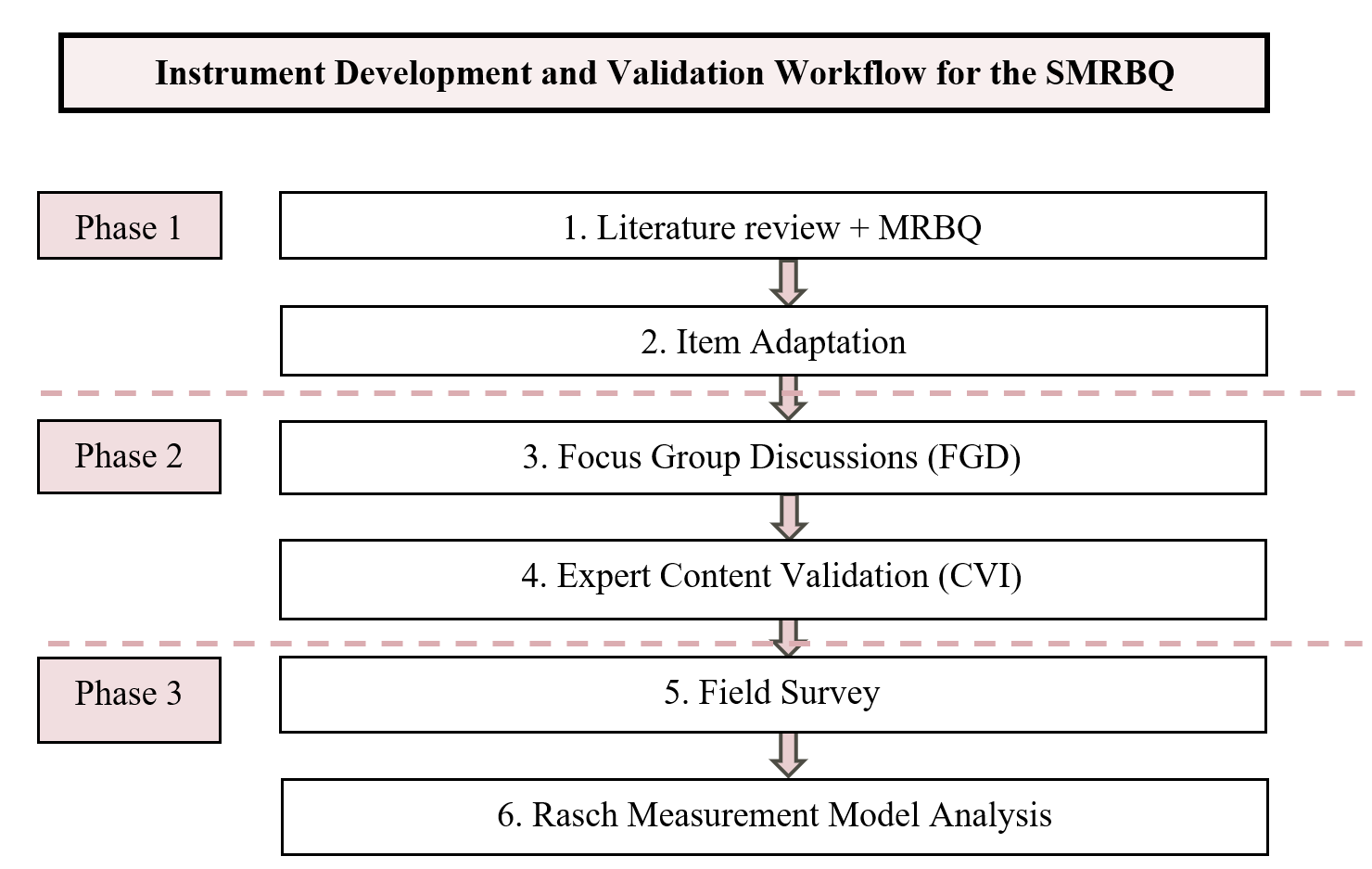
This study employed an instrument development research design to systematically develop and preliminarily evaluate a context-specific questionnaire for measuring motorcycle safety among Malaysian school motorcyclists. The instrument development process was guided by the recommendations of Boateng et al. (2018), integrating deductive and inductive approaches. The deductive approach was informed by the behavioural construct of the MRBQ (Elliott et al., 2007) together with relevant road safety literature, whereas the inductive approach incorporated contextual insights obtained through FGD involving road safety experts and school stakeholders. Consistent with the framework proposed by Boateng et al. (2018), the study involved instrument development, expert review and refinement, content validation, field administration and preliminary psychometric evaluation using the Rasch Measurement Model. The overall instrument development process is illustrated in Figure 1.
3.1 Instrument development
Instrument development commenced with a review of the MRBQ and relevant road safety literature to identify domains relevant to motorcycle safety among Malaysian school motorcyclists. The behavioural constructs of the MRBQ served as the foundation for the User Behaviour domain, while additional performance indicator domains were identified through the literature review to reflect broader aspects of motorcycle safety among school motorcyclists. The original MRBQ items were critically reviewed to determine their relevance to the Malaysian school riding context. Context-specific modifications included replacing terms such as motorway with main road and pelican crossing with zebra crossing to improve contextual suitability. Additional performance indicator domains were identified from the literature review and subsequently refined through FGD to reflect the contextual characteristics of Malaysian school motorcyclists. Table 2 summarises the primary sources and development approach for each performance indicator domain incorporated into the developed instrument.
| Performance indicator domain | Primary source | Development approach |
|---|---|---|
| User behaviour | MRBQ (Elliott et al., 2007) | Adapted and contextualised |
| Vehicle condition | Literature review + FGD | Newly developed |
| Road safety knowledge and emergency preparedness | Literature review + FGD | Newly developed |
| Physical environment | Literature review + FGD | Newly developed |
3.2 Focus group discussions (FGD)
Focus group discussions were conducted to refine the preliminary instrument by evaluating the relevance, comprehensiveness, and contextual suitability of the proposed performance indicator domains and questionnaire items. Six experts participated in the discussions, representing the Royal Malaysia Police (PDRM), the Road Transport Department Malaysia (JPJ), MIROS, school administration, school counselling, and academia. The focus group discussion lasted approximately 90 minutes and followed a semi-structured interview protocol focusing on the appropriateness of the proposed performance indicator domains, item wording, content coverage, and contextual relevance for Malaysian school motorcyclists. The thematic findings were used to refine the questionnaire domains and operationalise them into contextually appropriate questionnaire items. All discussions were audio-recorded, transcribed verbatim, and analysed using thematic analysis. Recommendations obtained from the FGD were incorporated through item revision, addition, deletion, and refinement to improve clarity, contextual appropriateness, and content coverage of the instrument.
3.3 Content validity
The content validity of the developed instrument was evaluated using the Content Validity Index (CVI). Experts independently assessed the relevance and clarity of each item based on the proposed performance indicator domains. The scale-level Content Validity Index (S-CVI) was calculated to determine the overall content validity of the instrument. The instrument achieved an S-CVI value of 0.97, indicating excellent agreement among experts regarding item relevance. According to Polit et al. (2007) and Zamanzadeh et al. (2015), an S-CVI value of 0.80 or above indicates satisfactory content validity. Although several items obtained relatively lower item-level CVI values, these items were revised according to expert recommendations before proceeding to field administration. The content validation process confirmed that the questionnaire adequately represented the intended motorcycle safety performance indicator domains prior to field administration.
3.4 Data collection
The developed instrument was administered to 163 secondary school motorcyclists from three Malaysian states, namely Pulau Pinang, Selangor, and Pahang. A multi-stage sampling approach was employed. First, the states were purposively selected to represent different geographical zones based on the highest reported number of motorcycle-related accidents involving school students within their respective zones. Subsequently, schools within the selected states were randomly selected. Eligible school motorcyclists were secondary school students who regularly rode motorcycles to school. The questionnaire consisted of 43 items across four measurement domains, namely User Behaviour, Vehicle Condition, Road Safety Knowledge and Emergency Preparedness, and Physical Environment. All items were rated using a five-point Likert scale ranging from 1 (Strongly Disagree) to 5 (Strongly Agree).
3.5 Psychometric evaluation using Rasch measurement model
The survey data were analysed using the Rasch Measurement Model implemented in Winsteps software to obtain preliminary evidence regarding the psychometric properties of the developed instrument. The Rasch Measurement Model was selected because it provides item-level diagnostics that assess item functioning, measurement precision, and the interaction between respondents and questionnaire items, thereby supporting the development of valid and reliable measurement instruments (Bond & Fox, 2015; Linacre, 2024). The psychometric evaluation examined item polarity using the Point-Measure Correlation (PTMEA CORR), item fit through the Infit and Outfit Mean Square (MNSQ) statistics, and measurement reliability using person and item reliability indices. Person and item separation indices were also evaluated to determine the instrument's ability to distinguish different levels of person measures and item difficulty. The criteria used for interpreting the Rasch output were based on recommendations by Bond and Fox (2015) and Linacre (2024), with acceptable values established for item polarity, item fit, reliability, and separation indices. Given the multidimensional structure of the questionnaire, Rasch analyses were conducted separately for each of the four measurement domains.
4. Findings
The first section (Sections 4.1 to 4.2) addresses RQ1 by describing the development of the instrument, including the establishment of the performance indicator domains and the contribution of the FGD to item refinement. The second section (Sections 4.3–4.4) addresses RQ2 through content validation and preliminary psychometric evaluation using the Rasch Measurement Model.
4.1 Focus group discussions findings
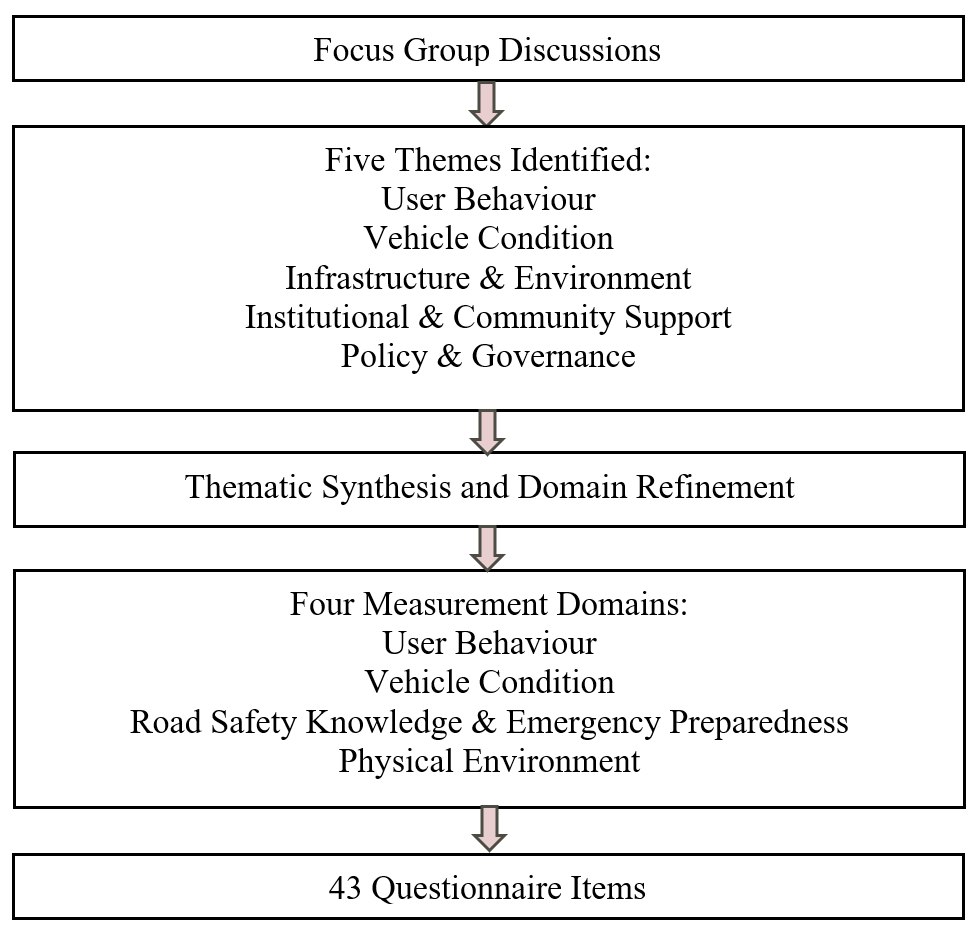
The thematic analysis of the FGD generated five overarching themes reflecting motorcycle safety among Malaysian school motorcyclists, namely User Behaviour, Vehicle Condition, Infrastructure and Environment, Institutional and Community Support, and Policy and Governance. These themes provided contextual evidence that complemented the literature review and guided the refinement of the questionnaire during the instrument development process. Rather than being adopted directly as questionnaire domains, the identified themes were synthesised to develop a conceptually coherent measurement structure suitable for assessing motorcycle safety among school motorcyclists.
The User Behaviour theme reaffirmed the behavioural constructs underpinning the MRBQ while identifying behaviours that were particularly relevant within the Malaysian school context. Experts highlighted issues related to rider maturity and experience, peer influence, compliance with traffic regulations, risky riding behaviours such as speeding and stunt riding, inconsistent use of protective equipment, riding without a valid licence, and distraction caused by mobile phone use. These findings supported the contextual adaptation and refinement of the original MRBQ behavioural constructs for Malaysian school motorcyclists.
The Vehicle Condition theme emphasised that motorcycle safety is also influenced by the mechanical condition and roadworthiness of motorcycles used by students. Participants highlighted indicators related to routine maintenance, tyre and braking conditions, unsafe vehicle modifications, the availability of essential safety features, and compliance with technical requirements. These findings justified the inclusion of a separate questionnaire domain assessing vehicle condition, which is not explicitly represented in the original MRBQ.
The Infrastructure and Environment theme highlighted the influence of the surrounding physical environment on motorcycle safety. Experts identified issues associated with school facilities, road surface quality, street lighting, dedicated motorcycle and pedestrian facilities, traffic congestion, heavy vehicles travelling near schools, and road signage. These findings demonstrated that environmental characteristics surrounding school travel may influence riding safety independently of rider behaviour and therefore warrant separate measurement.
Two additional themes, Institutional and Community Support and Policy and Governance, emerged during the discussions. Participants emphasised the importance of parental responsibility, school-based safety initiatives, enforcement by road safety agencies, community involvement, emergency assistance, licensing requirements, road safety education, and consistent enforcement of traffic regulations. Although these themes covered different organisational perspectives, they collectively reflected the knowledge, awareness, preparedness, and institutional support required for safe motorcycle use among school students. During instrument refinement, these themes were synthesised into the Road Safety Knowledge and Emergency Preparedness domain to avoid conceptual overlap while ensuring adequate coverage of educational and preparedness-related aspects of motorcycle safety.
Overall, the FGD findings confirmed that motorcycle safety among school motorcyclists should not be assessed solely through behavioural measures. Instead, the discussions demonstrated the need for a multidimensional questionnaire that integrates behavioural and contextual factors influencing motorcycle safety. Guided by the literature review, the behavioural foundation of the MRBQ, and the thematic synthesis of the FGD findings, the final questionnaire comprised four domains: User Behaviour, Vehicle Condition, Road Safety Knowledge and Emergency Preparedness, and Physical Environment. Figure 2 illustrates the thematic structure derived from the FGD and its contribution to the development of the questionnaire.
4.2 Development of the instrument
The instrument development process resulted in a context-specific questionnaire designed to measure motorcycle safety among Malaysian school motorcyclists. Building upon the behavioural measurement of the MRBQ, the developed instrument extends the scope of behavioural assessment by incorporating additional domains identified through the literature review and refined through FGD.
The final questionnaire comprised 43 items structured into four domains: User Behaviour, Vehicle Condition, Road Safety Knowledge and Emergency Preparedness, and Physical Environment. The User Behaviour domain was adapted and contextualised from the behavioural constructs of the original MRBQ, whereas the remaining three domains were developed to represent contextual aspects of motorcycle safety relevant to Malaysian school motorcyclists.
Unlike previous MRBQ adaptation studies that primarily retained the original behavioural framework, the present study expands the measurement capability of the MRBQ by operationalising additional motorcycle safety domains into measurable questionnaire items. This approach retains the established behavioural foundation of the MRBQ while providing a broader assessment of motorcycle safety suitable for Malaysian school motorcyclists. The composition of the developed questionnaire is presented in Table 3.
| Domain | Source | Number of items |
|---|---|---|
| User behaviour | Adapted from MRBQ | 20 |
| Vehicle condition | Literature review + FGD | 5 |
| Road safety knowledge and emergency preparedness | Literature review + FGD | 10 |
| Physical environment | Literature review + FGD | 8 |
| TOTAL | 43 |
4.3 Content validity
Content validity was evaluated through expert review to determine the relevance, clarity, and contextual suitability of the developed questionnaire prior to field administration. Six experts representing road safety agencies, academia, and school stakeholders independently assessed the questionnaire items according to the proposed measurement domains.
The questionnaire achieved a Scale-level Content Validity Index (S-CVI) of 0.97, exceeding the minimum acceptable value of 0.80 recommended by Polit et al. (2007) and indicating a high level of agreement among the experts regarding the relevance of the questionnaire content.
In addition to the quantitative assessment, the experts provided recommendations concerning item wording, contextual terminology, overlapping statements, and the inclusion of school-specific safety indicators. These recommendations were incorporated through item revision to improve clarity, contextual relevance, and content coverage while maintaining the conceptual structure of the questionnaire. No items were removed during the content validation process. Table 4 summarises the content validation results and the revisions undertaken before field administration.
| Aspect | Findings |
|---|---|
| Number of experts | 6 |
| Number of questionnaire items | 43 |
| Scale-level Content Validity Index (S-CVI) | 0.97 |
| Main expert recommendations | Refine wording for clarity and consistency; clarify ambiguous or context-specific terminology; reduce overlapping statements; incorporate school-specific safety indicators where appropriate |
| Action taken | Items were revised to improve clarity, contextual relevance, and content coverage; no items were removed |
4.4 Preliminary psychometric evaluation using the Rasch Measurement Model
Preliminary psychometric evaluation was conducted using the Rasch Measurement Model based on responses from 163 Malaysian school motorcyclists. As the developed questionnaire comprises four conceptually distinct motorcycle safety performance domains, Rasch analyses were conducted separately for User Behaviour (UB), Vehicle Condition (VC), Road Safety Knowledge and Emergency Preparedness (SK), and Physical Environment (PE). The evaluation focused on person and item reliability, separation indices, item polarity, item fit, and person-item targeting.
Table 5 presents the domain-specific Rasch measurement properties. Person reliability ranged from 0.70 to 0.79, while person separation ranged from 1.54 to 1.96. Item reliability ranged from 0.70 to 0.95, with item separation ranging from 1.51 to 4.23. The Vehicle Condition domain demonstrated the highest item reliability (0.95) and item separation (4.23), whereas the Physical Environment domain showed comparatively lower item reliability (0.70) and item separation (1.51). The Road Safety Knowledge and Emergency Preparedness domain recorded the lowest person reliability (0.70) and person separation (1.54).
| Domain | Items | Person reliability | Person separation | Item reliability | Item separation | Person mean (logits) |
|---|---|---|---|---|---|---|
| User behaviour (UB) | 20 | .78 | 1.88 | .94 | 3.83 | +1.42 |
| Vehicle condition (VC) | 5 | .79 | 1.96 | .95 | 4.23 | +2.16 |
| Road safety knowledge & emergency preparedness (SK) | 10 | .70 | 1.54 | .93 | 3.62 | +3.14 |
| Physical environment (PE) | 8 | .79 | 1.96 | .70 | 1.51 | +1.43 |
All items demonstrated positive Point-Measure Correlation (PTMEA CORR) values within their respective domains, indicating that the items functioned in the intended direction of measurement. However, examination of the Infit and Outfit MNSQ statistics identified several items requiring further evaluation. Using the predetermined acceptable range of 0.60–1.40, eight items demonstrated fit statistics outside the acceptable range. Seven items showed underfit on either Infit or Outfit MNSQ: UB1, UB3, UB18, UB20, VC5, SK1, and PE7, while UB14 demonstrated slight overfit, with an Infit MNSQ value of 0.56.
Within the User Behaviour domain, UB18 and UB20 exhibited the largest departures from model expectations, with Infit MNSQ values of 1.93 and 1.99, respectively. UB1 and UB3 demonstrated acceptable Infit but elevated Outfit values of 1.58 and 1.61. UB14 showed slight overfit (Infit = 0.56), suggesting responses that were more predictable than expected by the model. Nevertheless, all UB items retained positive PTMEA CORR values.
For Vehicle Condition, VC5 was the only item demonstrating substantial underfit (Infit = 1.80; Outfit = 1.78), while the remaining four items were within the predetermined fit range. Within Road Safety Knowledge and Emergency Preparedness, only SK1 exceeded the criterion through its Outfit MNSQ of 1.51, while its Infit remained acceptable at 1.10. Similarly, PE7 was the only Physical Environment item showing substantial underfit (Infit = 1.85; Outfit = 1.73).
| Domain | Item | Infit MNSQ | Outfit MNSQ | PTMEA CORR | Observation |
|---|---|---|---|---|---|
| UB | UB20 | 1.99 | 1.64 | .36 | Underfit |
| UB | UB18 | 1.93 | 1.41 | .38 | Underfit |
| UB | UB3 | 1.31 | 1.61 | .53 | Outfit underfit |
| UB | UB1 | 1.33 | 1.58 | .33 | Outfit underfit |
| UB | UB14 | .56 | .63 | .56 | Slight overfit |
| VC | VC5 | 1.80 | 1.78 | .58 | Underfit |
| SK | SK1 | 1.10 | 1.51 | .56 | Outfit underfit |
| PE | PE7 | 1.85 | 1.73 | .55 | Underfit |
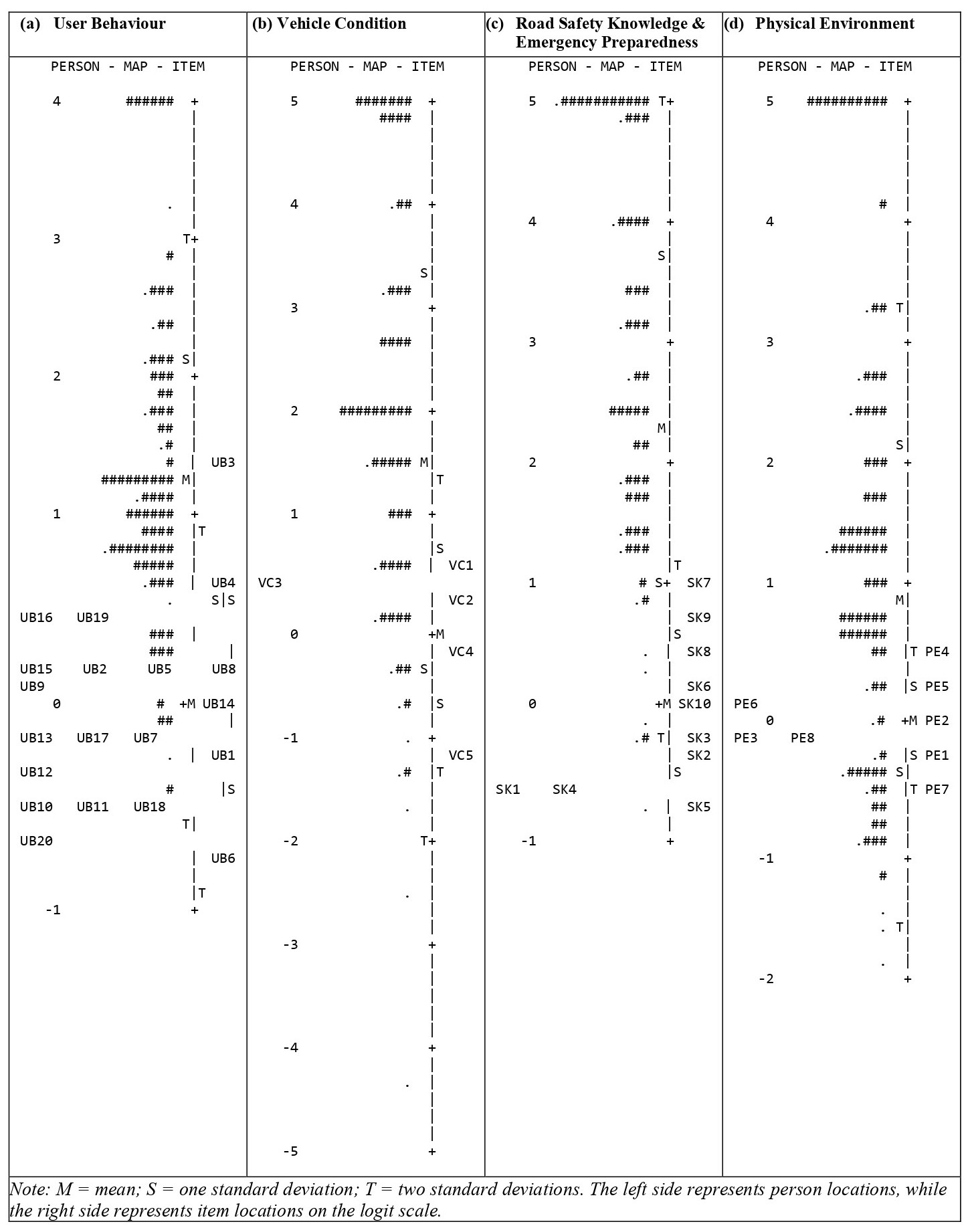
Person-item targeting was further examined using Wright maps for each domain (Figure 3). The maps positioned respondents and items on the same logit scale, enabling examination of the correspondence between respondent levels and item locations. Across the four domains, respondent distributions generally extended above the item distributions, indicating that several questionnaire items were relatively easy to endorse for the present sample. This pattern was particularly evident for the Road Safety Knowledge and Emergency Preparedness domain, which recorded the highest person mean (+3.14 logits).
The Wright maps also demonstrated differences in item spread across domains. User Behaviour, Vehicle Condition, and Road Safety Knowledge and Emergency Preparedness showed discernible hierarchies of item locations, whereas the Physical Environment items were more closely clustered. This pattern corresponded with the comparatively lower item separation observed for the Physical Environment domain (1.51). Overall, the Wright maps provide additional evidence regarding item targeting and identify areas where future item refinement may improve coverage across the measurement continuum.
In summary, the domain-specific Rasch analyses provided preliminary evidence supporting the measurement performance of the developed questionnaire while also identifying areas requiring further refinement. Most items functioned in the intended direction, and strong item reliability and separation were observed particularly for the User Behaviour, Vehicle Condition, and Road Safety Knowledge and Emergency Preparedness domains. However, several item-level misfits, comparatively lower person separation, limited upper-end targeting, and lower item separation within the Physical Environment domain indicate that further psychometric evaluation and item refinement are warranted.
5. Discussion
This study developed a multidimensional questionnaire for assessing motorcycle safety among Malaysian school motorcyclists by extending the behavioural measurement foundation of the MRBQ. The findings demonstrate that although the MRBQ provides an established basis for measuring riding behaviour, assessment of motorcycle safety among school motorcyclists requires consideration of factors beyond behaviour alone. By integrating evidence from the literature, the behavioural foundation of the MRBQ, contextual insights from FGD, and expert evaluation, the study developed a broader multidimensional measurement approach while retaining the established behavioural strengths of the MRBQ.
5.1 Development of a multidimensional motorcycle safety instrument
The principal contribution of this study lies in extending the measurement scope of the MRBQ beyond its original behavioural orientation. Previous MRBQ adaptations have predominantly focused on linguistic and cultural adaptation while retaining behavioural factors such as traffic errors, control errors, speed violations, stunts, and safety equipment use (Cheng & Ng, 2010; Elliott et al., 2007; Ferko et al., 2025; Motevalian et al., 2011). Such adaptations remain valuable for understanding rider behaviour; however, they may provide only a partial representation of motorcycle safety when applied to school motorcyclists whose safety is also influenced by the condition of their motorcycles, their safety knowledge and preparedness, and the physical environments in which they travel.
The multidimensional structure developed in this study is consistent with broader perspectives in road safety research. The Safe System approach conceptualises road safety as the outcome of interactions among road users, vehicles, roads, and the wider transport system rather than as the responsibility of individual road users alone (WHO, 2018). Similarly, Haddon (1980) emphasised interactions among human, vehicle, and environmental factors in injury prevention. From a measurement perspective, the Safety Performance Indicator literature further supports the assessment of intermediate factors associated with safety rather than relying exclusively on crash outcomes (Elvik, 2009; Hutchinson, 2018; Wegman et al., 2008). The four-domain structure identified in the present study therefore provides a means of operationalising these broader safety dimensions into measurable questionnaire items relevant to school motorcyclists.
Importantly, the developed questionnaire should not be interpreted as a replacement for the MRBQ or as a newly proposed Safety Performance Indicator framework. Instead, the MRBQ serves as an established psychometric and behavioural foundation from which the measurement scope was extended. This distinction is important because the contribution of the present study lies primarily in instrument development and operationalisation: established behavioural measures were contextualised for school motorcyclists, while additional safety-related domains were incorporated to provide broader measurement coverage.
5.2 Contribution of the instrument development process
The integration of deductive and inductive evidence was particularly important in establishing the contextual relevance of the developed questionnaire. The deductive component provided an established foundation through the MRBQ and road safety literature, whereas the FGD allowed safety issues specific to Malaysian school motorcyclists to emerge from experts and stakeholders familiar with their riding environment. This combined approach is consistent with recommendations that instrument development should integrate theoretical evidence with input from the target context rather than relying solely on the modification of an existing scale (Boateng et al., 2018).
The FGD findings further demonstrated the value of distinguishing between qualitative themes and measurement domains. Five overarching themes emerged from the discussions: User Behaviour, Vehicle Condition, Infrastructure and Environment, Institutional and Community Support, and Policy and Governance, whereas the final questionnaire comprised four measurement domains. The transition from five qualitative themes to four questionnaire domains reflects a process of thematic synthesis rather than direct conversion of each qualitative theme into a separate construct. Institutional, community, and policy-related insights contributed particularly to the operationalisation of road safety knowledge, awareness, and emergency preparedness, while infrastructure-related findings informed the Physical Environment domain. This synthesis reduced conceptual overlap while retaining contextually important content identified during the FGD.
Expert content validation subsequently strengthened this process by evaluating whether the resulting items adequately represented their intended domains. The high level of expert agreement supports the content relevance of the questionnaire, while qualitative recommendations concerning wording, ambiguity, redundancy, and contextual specificity enabled further refinement before empirical evaluation. Thus, expert validation functioned not merely as a statistical assessment of content validity but as an additional stage of instrument refinement.
5.3 Psychometric evidence of the developed instrument
The domain-specific Rasch analyses provided preliminary evidence regarding the measurement performance of the developed questionnaire while also identifying areas requiring further refinement. The four domains demonstrated different measurement characteristics, reflecting their distinct conceptual content. Item reliability and separation were particularly strong for User Behaviour, Vehicle Condition, and Road Safety Knowledge and Emergency Preparedness, indicating relatively stable item hierarchies within these domains. In contrast, person reliability and separation were more moderate across the four domains, suggesting a comparatively limited ability to distinguish respondents across multiple levels of the measured attributes. The Physical Environment domain demonstrated lower item reliability and separation than the other domains, indicating a narrower spread of item locations and suggesting that additional or more discriminating items may be required to improve measurement coverage within this domain.
The application of the Rasch Measurement Model adds an important measurement perspective to the instrument development process. Previous MRBQ adaptations have commonly relied on classical psychometric approaches to examine reliability and factor structure, whereas Rasch analysis enables the functioning of individual items to be examined within a common measurement framework. In the present study, all items demonstrated positive PTMEA CORR values, indicating that they functioned in the intended direction of their respective domains. However, the item-fit analysis identified several items requiring further evaluation, demonstrating the value of examining item-level performance rather than relying solely on overall reliability coefficients.
Specifically, seven items demonstrated underfit based on the predetermined Infit and Outfit MNSQ range of 0.60–1.40: UB1, UB3, UB18, UB20, VC5, SK1, and PE7, while UB14 demonstrated slight overfit. The occurrence of misfit across all four domains suggests that item functioning should be interpreted in relation to the specific content represented by each domain rather than as a problem confined to the behavioural component of the instrument. Misfitting items do not necessarily indicate conceptual irrelevance; instead, they may reflect heterogeneous response patterns, differences in respondents' experiences, or item characteristics that are not fully consistent with model expectations. Given the preliminary nature of the present evaluation and the conceptual and contextual relevance of these items established during instrument development, the items were retained at this stage. Nevertheless, their wording and empirical performance should be re-examined using larger and more diverse samples before decisions regarding further revision or removal are made.
The Wright maps provided further insight into person-item targeting across the four domains. Respondent distributions generally extended above the item distributions, indicating that the item locations were generally lower than the respondent locations and that the instrument provided comparatively limited targeting at the higher levels of the measured attributes. This pattern was particularly evident for Road Safety Knowledge and Emergency Preparedness, which recorded the highest person mean (+3.14 logits), suggesting limited item coverage at the upper end of the measurement continuum. The Physical Environment domain also displayed a relatively narrow clustering of items, consistent with its lower item separation index. These findings suggest that future refinement should consider incorporating more discriminating items at the upper levels of the measured attributes, particularly in domains where gaps between respondent and item locations were evident.
Taken together, the expert content validation and domain-specific Rasch analyses provide complementary forms of preliminary evidence for the developed instrument. Expert evaluation supports the relevance and representativeness of its content, whereas Rasch analysis provides empirical evidence regarding item directionality, reliability, separation, item fit, and person-item targeting. Rather than indicating definitive psychometric validation, the findings support the questionnaire as a promising multidimensional measurement instrument while simultaneously identifying specific areas for further refinement and validation.
5.4 Practical and research implications
The developed questionnaire has several potential applications for motorcycle safety research and practice. By measuring behavioural and contextual dimensions within a single instrument, it can provide a broader profile of motorcycle safety among school motorcyclists than behavioural assessment alone. For example, poor safety performance may reflect unsafe riding practices, inadequate motorcycle condition, limited road safety knowledge or emergency preparedness, unfavourable physical environments, or a combination of these factors. Such differentiation may assist researchers and relevant stakeholders in identifying areas requiring further investigation or targeted intervention.
For schools and road safety stakeholders, the questionnaire may also provide a structured assessment tool for identifying safety-related weaknesses among school motorcyclists and their commuting environments. The resulting information could support the planning of road safety education, motorcycle maintenance awareness, emergency preparedness programmes, and improvements to school-zone environments. However, these applications should be considered prospective until the instrument undergoes further validation across broader populations.
From a research perspective, the study demonstrates how an established behavioural questionnaire can serve as the foundation for broader instrument development without discarding its original psychometric strengths. The approach may be particularly relevant when existing instruments adequately measure one component of a complex safety phenomenon but do not capture other contextually important dimensions. Future studies should therefore examine the stability of the four-domain structure, reassess items showing Rasch misfit, and evaluate the questionnaire across different geographical and demographic groups.
6. Conclusion
This study developed a context-specific, multidimensional questionnaire for assessing motorcycle safety among Malaysian school motorcyclists by systematically extending the behavioural measurement foundation of the MRBQ. Rather than functioning solely as a behavioural assessment tool, the developed instrument provides broader measurement coverage of behavioural and contextual factors relevant to motorcycle safety among school motorcyclists. The integration of literature evidence, FGD, and expert review enabled established MRBQ behavioural measures to be contextualised while additional safety-related domains were operationalised into measurable questionnaire items. The findings provide encouraging preliminary evidence supporting the developed instrument. Expert evaluation demonstrated strong content validity, and Rasch analysis provided preliminary evidence of measurement performance across the four domains while identifying limitations in person differentiation, item targeting, and the functioning of several items. Collectively, these findings suggest that the instrument provides a promising foundation for multidimensional assessment of motorcycle safety among Malaysian school motorcyclists. The study contributes to motorcycle safety measurement by demonstrating how an established behavioural instrument can be systematically extended to incorporate broader contextual dimensions without replacing its original behavioural foundation. Further validation using larger and more geographically diverse samples is required to confirm the stability of the proposed domains and refine the measurement properties of individual items. With further validation, the instrument may support future research and targeted assessment of motorcycle safety among school motorcyclists.
7. Limitations and future research
Several limitations should be considered when interpreting the findings of this study. First, the preliminary psychometric evaluation involved 163 school motorcyclists from three Malaysian states, which may limit the generalisability of the findings to the broader population of school motorcyclists across Malaysia. Although the selected states represented different geographical contexts, future studies should include larger and more geographically diverse samples to examine the consistency of the instrument across different riding environments and populations. Second, the present study provides preliminary psychometric evidence rather than definitive validation of the proposed measurement structure. Although the Rasch analysis provided encouraging preliminary evidence of measurement performance, several items exhibited fit statistics beyond the recommended range and were retained because of their conceptual and contextual relevance. These items should be re-examined using larger independent samples to determine whether further refinement, rewording, or removal is necessary. Finally, the present study focused on the initial development, content validation, and Rasch-based evaluation of the questionnaire. Further research should examine the stability of the proposed four-domain structure and establish additional evidence of validity across different populations and settings. Such validation would strengthen confidence in the instrument and support its broader application in assessing motorcycle safety among school motorcyclists.
CRediT contribution
Siti Nazirah Kamaruddin: Conceptualization, Data curation, Formal analysis, Investigation, Methodology, Validation, Visualization, Writing – original draft, Writing – review & editing. Mazdi Marzuki: Conceptualization, Methodology, Supervision, Validation, Writing – review & editing. Nor Mashitah Mohd Radzi: Investigation, Methodology, Validation, Writing – review & editing. Kamarul Ismail: Resources, Supervision, Validation, Writing – review & editing. Harifah Mohd Noor: Investigation, Validation, Writing – review & editing.
Acknowledgements
The authors would like to express their sincere appreciation to the Ministry of Higher Education Malaysia (MOHE) for supporting this research under the Fundamental Research Grant Scheme (FRGS), Grant No. FRGS/1/2024/SS07/UPSI/02/3 (Research Code: 2024-0080-106-02). The authors are also grateful to the Royal Malaysia Police (PDRM), Road Transport Department Malaysia (JPJ), and Malaysian Institute of Road Safety Research (MIROS) for their valuable contributions during the Focus Group Discussions. Special thanks are extended to the school counsellors and administrators for their participation and insights, as well as to the experts involved in the content validation process for their constructive feedback in improving the instrument.
Declaration of competing interests
The authors report no competing interests.
Declaration of generative AI use
During the preparation of this work, the authors used ChatGPT (OpenAI) to assist in refining the language, structure, and clarity of the manuscript. All outputs were carefully reviewed, revised, and validated by the authors, who take full responsibility for the content of the publication.
Prior dissemination declaration
This manuscript presents original work that has not been previously published or disseminated in any form.
Ethics statement
The study was conducted in accordance with established ethical guidelines for research involving human participants. Ethical approval for this study was obtained from Universiti Pendidikan Sultan Idris (UPSI). All participants were informed about the purpose of the study, and informed consent was obtained prior to data collection. Participant confidentiality and anonymity were strictly maintained throughout the research process.
Funding statement
This study was supported by the Fundamental Research Grant Scheme (FRGS), Ministry of Higher Education Malaysia (Grant No. FRGS/1/2024/SS07/UPSI/02/3).
Data availability statement
The data are available upon reasonable request, subject to ethical approval.
Code availability statement
No custom code or scripts were developed for this study. The Rasch Measurement Model analyses were conducted using Winsteps, proprietary software. Therefore, there is no author-developed source code associated with this study.
Editorial information
Handling editor: Sonja Forward, Swedish National Road and Transport Research Institute (VTI), Sweden.
Reviewer: Savalee Uttra, Kalasin University, Thailand.
Submitted: 3 April 2026; Accepted: 14 September 2026; Published: 2 October 2026.