Summer use of winter tyres and the effect on fatal passenger car accidents
Abstract
Accidents related to insufficient road grip in Sweden have historically been investigated for winter conditions, where substantial effect on passenger car accident risk from different types of tyres has been observed. Grip-related accidents during summer conditions have so far primarily focused on the effect of Electronic Stability Control (ESC), with no assessment of possible influence from tyre properties. The use of winter tyres during summer has been increasing among passenger cars in Sweden and is currently estimated to be around 7%. Tyre tests indicate 20%–40% longer braking distances for winter tyres compared to summer tyres, and statistics have indicated that passenger cars with winter tyres are heavily overrepresented among the fatal accidents during the summer period in Sweden. The purpose of this study has therefore been to estimate the potential risk increase for a fatal grip-related accident for passenger cars using winter tyres, compared to summer tyres, during summer. Statistics from in-depth studies of fatal road accidents in Sweden from the 10-year period 2012–2021 was used in an induced exposure risk analysis, with a complementary stratified analysis investigating the effect of possible confounding factors. The results indicate that the overrepresentation among fatal accidents of cars equipped with winter tyres during the summer period to a large extent is related to the inferior road grip of winter tyres. The risk increase was particularly high for fatal grip related accidents when driving within the regulated speed limit. Tyre properties have generally been neglected as a contributing factor among fatal accidents occurring in the summer period in the Swedish in-depth studies. The present study shows that tyres have a substantial impact on grip-related fatal accidents with passenger cars in Sweden during the summer period, which account for 25% of the fatal accidents involving passenger cars. This highlights the need for increased attention to tyre properties in accident investigations. The results are most likely relevant also to other countries where winter tyres are used and the findings should be addressed by policy makers and other stakeholders.
1. Background
It is well known that a modern tyre is a compromise between several desirable properties, such as high road grip, low rolling resistance and noise, and high wear resistance for different types of surfaces. Increasing performance of one property often leads to reduced performance of other ones, see e.g. Gent and Walter (2006). This has led to the evolution of different tyre types, each prioritizing some specific properties. For example, off-road tyres, racing tyres, and recently also tyres especially developed for low rolling resistance. From a traffic safety point of view, the most obvious is probably the differentiation between summer and winter tyres. In Sweden a winter tyre regulation for passenger cars and other light vehicles was introduced on 1 December 1999, making it mandatory for those vehicles to be equipped with winter tyres when travelling on the road when winter conditions prevail during the period 1 December to 31 March. This regulation resulted in an increased use of winter tyres from 90% to close to 100%, and an estimated yearly decrease of around 55 severely injured persons and 7–9 less killed in traffic (Öberg et al., 2002).
Winter tyres can be further subdivided into different types. The Scandinavian Tire and Rim Organization (STRO) recognize three main types: studded tyres, studless winter tyres made for Nordic conditions, and studless winter tyres made for central European conditions. All-season tyres are hybrids between summer and winter tyres and were first allowed for use in Sweden during the winter period in 2019, when the regulations were changed. Hence, their market share is low, less than 1% (Grönvall, 2025). The main advantages of studded tyres compared to studless are the ability to generate grip on slippery ice, and to maintain lateral friction forces for large steering angles and in skidding situations. Tyre grip is the friction and adhesion between a vehicle’s tyres and the road surface, which enables safe braking, acceleration and cornering without skidding. The maximum attainable grip is often quantified by brake tests, sometimes complemented by cornering or lane change manoeuvres. The studless winter tyres for Nordic conditions are constructed in a similar way to studded tyres, with a soft rubber mixture and tread pattern optimised for generating grip on snow and rough ice. In contrast, the studless winter tyres for central European conditions are to a higher degree prioritizing grip on dry or wet asphalt in low temperatures, at the expense of grip on snow and ice. Central European winter tyres are also constructed for higher speeds compared to the Nordic counterparts. The general difference in grip on different winter road conditions between the types of winter tyres can be substantial and has been quantified by Hjort et al., (2017) in a test comprising 80 different tyre models. Strandroth et al., (2012) showed that the difference in grip translates into vastly different risks for a fatal loss of control accident on ice- or snow-covered roads in Sweden for passenger cars without electronic stability control (ESC). The use of studded tires was found to have a statistically significant effect of 42% in terms of fatal crash reduction, compared to non-studded winter tires in general, and 31% and 49% compared to Nordic or central European studless winter tires respectively. The authors argued that these differences would diminish significantly when ESC systems became standard equipment. Strandroth et al., (2015) showed a 92% risk reduction in fatal loss of control crashes during the winter period for cars with ESC compared to without ESC, for all types winter tyres combined. ESC is a system that counteracts vehicle oversteering (excessive rotation around the vertical axis), heading the vehicle in the driver’s intended direction according to the steering wheel position. Most ESC systems have not been made to suppress understeering (insufficient lateral movement when steering) on high-coefficient-of-friction surfaces and have no effect on braking distance (NHTSA, 2007).
In Sweden, studded tyres have traditionally been the norm among winter tyres, with a share of 80% around year 2000. Their market share has, however, steadily declined since then, and by 2025 was down to 49% (Grönvall, 2025). At the same time, an increased use of winter tyres during summer has been observed among passenger cars in Sweden. The overall number is around 7% according to a study by Grönvall (2021). Since the use of studded tyres is banned during summer, while studless winter tyres are not, it is plausible that the increased use of studless winter tyres during the winter period leads to an increased use of these tyres during the summer. From analysing tyre use in different regions of Sweden, Grönvall found a clear correlation between the use of studless winter tyres during summer and winter time. It has been demonstrated that winter tyres have substantially lower grip compared to summer tyres on wet or dry asphalt in summer conditions. Tests performed by VTI indicate that the braking distance of new Nordic winter tyres generally is 15–45% longer compared to new summer tyres, where the difference is elevated with increased ambient temperature (Hjort et al., 2015 and 2023). The detrimental effect of high temperature on winter tyre braking distance has also been documented by Žuraulis et al. (2018). Whether the lower grip also leads to an increased accident risk when using winter tyres during the summer period in Sweden is however not known. Grönvall (2021) analysed statistics of fatal road accidents involving passenger cars in Sweden between 2010 and 2019 during the period May to September and concluded that at least 17% of the cars were equipped with winter tyres. Considering an estimated share of 7% for winter tyres during summer, these tyres are strongly overrepresented in fatal accidents. However, overrepresentation in accident statistics does not necessarily translate into increased risk, since vehicle mileage and possible confounding factors may affect the statistics. The aim of this study has therefore been to investigate the possible increased risk of using winter tyres during the summer period in Sweden, accounting for milage and confounding factors.
2. Methodology
The Swedish data base of traffic accidents, STRADA (Swedish Traffic Accident Data Acquisition) does unfortunately not contain any information about tyres. However, the fatal accidents are routinely analysed in detail by the Swedish Traffic Agency, in so called In-depth studies, where also tyre data is noted. The data from the in-depth studies has been used in this study. To investigate whether the use of winter tyres during the summer period in Sweden leads to an increased accident risk, fatal accidents from the 10-year period 2012–2021 were studied. The summer period was defined as May to September. The accident data were analysed using the induced exposure method, which has frequently been utilized in the past for assessing traffic safety effects of various advanced driver assistance systems (ADAS), (Evans, 1999; Tingvall et al., 2003; Kreiss et al., 2005). It is based on case-control methodology often used in medical studies (see e.g. Schlesselman, 1982 for a detailed background), utilizing the odds ratio
\begin{eqnarray} R = \frac{A_{w}}{N_{w}}\text{/}\frac{A_{s}}{N_{s}}\tag{1} \end{eqnarray}
with
Aw: the number of accidents involving a car equipped with winter tyres where the road grip of that vehicle most likely had an impact on the accident outcome.
Nw: the number of accidents involving a car equipped with winter tyres where the road grip of that vehicle did not have an impact on the accident outcome.
As: the number of accidents involving a car equipped with summer tyres where the road grip of that vehicle most likely had an impact on the accident outcome.
Ns: the number of accidents involving a car equipped with summer tyres where the road grip of that vehicle did not have an impact on the accident outcome.
If R=1 the effect of winter tyres is zero, R<1 indicates a reduced risk, and R>1 indicates an increased risk when using winter tyres. While R is an odds ratio, and not a probability ratio, but because the probability of a crash event is very low it is a good approximation of the relative risk of using winter tyres compared to summer tyres, and will thus be interpreted in that way. It should be noted however, that for large values of R there is a risk of overestimating the related risk increase (Zhang and Yu, 1998). Since our hypothesis is that the use of winter tyres is associated with an increased risk, it is convenient to introduce the effect quantity \(E = 100 \times (R - 1)\)%. E shall be interpreted as the relative risk increase of a fatal accident occurring during the summer period due to insufficient road grip for a passenger equipped with winter tyres compared to summer tyres.
Confidence intervals can be determined via the logarithm of the odds ratio R, which in contrast to R, is symmetrically around the expected value with an approximate normal distribution. The standard error of the logged odds ratio is
\begin{eqnarray} \sigma_{\ln(R)} = \sqrt{\frac{1}{A_{w}} + \frac{1}{N_{w}} + \frac{1}{A_{s}} + \frac{1}{N_{s}}}\tag{2} \end{eqnarray}
A confidence interval (CI) for the logged odds ratio at a 95% confidence limit can be achieved by multiplying the standard error by 1.96. Thus, using the natural logarithm, the upper and lower confidence limits of R are given by
\begin{eqnarray} R_{\text{upper limit}} = \text{exp}\left( \text{ln}(R) + 1.96 \cdot \sigma_{\text{ln}(R)} \right)\tag{3} \end{eqnarray}
\begin{eqnarray} R_{\text{lower limit}} = \text{exp}\left( \text{ln}(R) - 1.96 \cdot \sigma_{\text{ln}(R)} \right)\tag{4} \end{eqnarray}
In general, the CI is not symmetrical with respect to R.
Fatal accidents involving passenger cars in Sweden during the summer period, here defined as May to September, were investigated. In-depth studies of these fatal accidents have previously been carried out by the Swedish Transport Administration, and the essential part of their analysis has been made available to the present study. The data includes e.g. detailed accident conditions, vehicle speeding assessment and whether the driver suffered from a medical condition leading to the accident. There is however no variable stating responsibility in non-single accidents, or any assessment regarding insufficient road grip. Such assessments had to be made by the authors based on the detailed sequence of events describing the accident, and reports on possible skid marks. In unclear situations, Vehicle trajectories from the police report were used. The involvement of the passenger cars in each accident was classified according to whether insufficient road grip played a major role in the accident outcome. This classification was made according to Table 1 and was done without a priori knowledge of the tyres used. Each accident was reviewed separately by two of the authors and accidents with disagreement of the classification were then discussed between those authors, most often leading to a consensus. Border-line cases where agreement was not found by the two authors (<10% of all accidents) were further analysed in a consensus group consisting of all four authors together with an accident analysis expert from the Swedish Transport Administration. Ultimately, a consensus classification was reached for all accidents. An example of such border-line case is a single accident where the driver fails to negotiate a curve and the descriptive information in the data is not sufficient to conclude whether the driver had steered/braked or not.
| Classification | Insufficient road grip affected accident outcome | Classification instructions |
|---|---|---|
| 1 | Most likely | Accidents where the outcome most likely would have been affected by increased road grip, to the extent that a fatal accident possibly could have been avoided. |
| 2 | Possible | Accidents where the outcome could have been affected by increased grip, but cannot be established from the existing scenario description. |
| 3 | Possible, but not likely | Accidents where the outcome likely would not have been affected by increased road grip, but from the existing scenario description cannot be entirely ruled out. |
| 4 | Not at all | Accidents where increased road grip would have no effect on the outcome. |
One passenger car per fatal accident was selected for the analysis. In case an accident involved more than one passenger car, the one with the highest likelihood that insufficient road grip had an impact on the accident (i.e. the one with the lowest classification (Table 1)) was chosen. Hence, the number of cars classified as 4 was slightly smaller compared to if more than one car per accident was included. This did however not affect the odds ratio, since there was no bias between tyre types in the selection process.
The induced exposure method implicitly accounts for unknown vehicle milage by dividing a group of accidents that are affected by the road grip, with a group that is unaffected by road grip. The method also, most likely, accounts for other non-grip-related confounding factors such as occupant sex, age and driver behaviour. The term confounding factor refers to uncontrolled or unknown variables that co-vary with both dependent and independent factors. Confounding factors that are likely to affect the grip sensitive accidents differently than accidents unrelated to grip, need to be investigated separately. This was done by stratifying the data according to plausible confounding factors and performing the odds ratio analysis for each case. The main plausible confounding factors were identified as whether the car was equipped with Electronic Stability Control system (ESC), vehicle age, speeding, intoxicated driver and tyre tread depth.
After excluding accidents suspected to involve suicide, there were a total of 725 fatal accidents involving at least one passenger car during the chosen time period. Out of the selected passenger cars, 214 lacked tyre information for all four wheels, while 31 had partial information of the tyre types, of which 3 had at least one known winter tyre and 28 had no known winter tyre (Figure 1). Of the cars with complete tyre information, 82 (17%) were equipped with four winter tyres and 374 (78%) with four summer tyres. In addition, there were 24 accidents (5%) where the car was equipped with a mixture of summer and winter tyres. The winter tyres were mostly studless, although 11 cars were equipped with studded tyres. Since studless winter tyres for Nordic conditions and studded tyres in general have very similar grip on bare asphalt (Hjort et al., 2017), it was reasonable to combine studded and studless winter tyres as one group.

Out of the 725 selected cars, 24% were classified as group 1 (most likely that better grip would have affected the outcome), 18% were classified as group 2 (possible that better grip would have affected the outcome), 27% were classified as group 3 (possible, but not likely that better grip would have affected the outcome), and 31% were classified as group 4 (not at all likely that better grip would have affected the outcome). Detailed data description statistics are presented in Appendix 1.
Due to the relatively small number of accidents in the material, risk analyses carried out for subsets of the data had large uncertainties. Therefore, an analysis of the larger group of cars equipped with at least one winter tyre (n=109) was carried out first, followed by a corresponding analysis for the smaller group of cars equipped with four winter tyres (n=82). The effect of possible confounding factors was evaluated from separate risk analyses using stratified data. In addition, logistic regression analyses were performed as a sensitivity analysis.
3. Results
3.1 Cars equipped with at least one winter tyre
As an initial analysis of the fatal accidents, passenger cars equipped with at least one winter tyre (109 cars) were compared to cars equipped with four summer tyres (374 cars). The relative risk increase for driving with at least one winter tyre, compared to only summer tyres was found to be 106% when comparing group 1 and 4, as shown in Table 2. The risk increase is statistically significant, although the confidence interval is large (12% to 280%) due to the relatively low number of accidents. Increasing the number of accidents by comparing the combined groups of (1+2) with (3+4) led to a reduction of the relative risk and a narrower confidence interval, as could be expected, but these results were non-significant.
| Classification groups | Winter tyres (at least one) | Summer tyres | Effect and confidence interval | ||||
|---|---|---|---|---|---|---|---|
| Grip-related accidents | Non-grip-related accidents | Grip-related accidents | Non-grip-related accidents | R | E % | CI % | |
| 1 vs 4 | 34 | 21 | 88 | 112 | 2.06 | 106 | (12 to 280) |
| (1+2) vs (3+4) | 57 | 52 | 160 | 214 | 1.47 | 47 | (-4 to 125) |
An analysis with stratified data was carried out to investigate the effect of the suspected confounding factors, as presented in Table 3.
| Winter tyres (at least one) | Summer tyres | Effect and confidence interval | ||||||
|---|---|---|---|---|---|---|---|---|
| Grip-related accidents | Non-grip-related accidents | Grip-related accidents | Non-grip-related accidents | R | E (%) | CI (%) | ||
| ESC system | Yes | 12 | 10 | 45 | 81 | 2.16 | 116 | (-14 to 439) |
| No | 20 | 11 | 38 | 28 | 1.34 | 34 | (-45 to 224) | |
| Speed | Within regulated | 7 | 16 | 10 | 96 | 4.20 | 320 | (40 to 1164) |
| Above regulated (<30 km/h) | 14 | < 5 | 24 | 9 | - | - | - | |
| Above regulated (≥30 km/h) | 13 | < 5 | 46 | < 5 | - | - | - | |
| Vehicle age | 0 – 10 years | 9 | 7 | 26 | 68 | 3.36 | 236 | (14 to 896) |
| > 10 years | 25 | 14 | 62 | 43 | 1.24 | 24 | (-42 to 165) | |
| Intoxicated driver | Yes | 12 | < 5 | 40 | < 5 | - | - | - |
| No | 20 | 17 | 44 | 100 | 2.67 | 167 | (28 to 459) | |
3.1.1 Tread depth
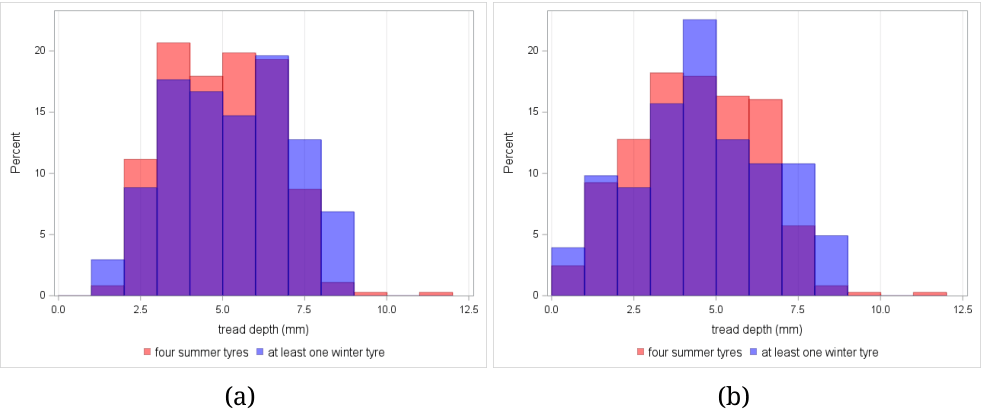
The tread depth may have an impact on accident risk (Hantula, 1998; Pečeliūnas et al., 2022). Average tyre tread depth of the four wheels was 4.9 mm for summer tyres (all four groups combined), 5.1 mm for cars with at least one winter tyre, and 5.4 mm for cars with four winter tyres. The average tyre tread depth of the most worn tyre on all cars was 4.1 mm for summer tyres, 4.3 for at least one winter tyre, and 4.7 mm for four winter tyres. Hypothetically, winter tyres could still be over-represented for small tread depths. However, as confirmed by Figure 2 showing the distribution of average tread depth of the four tyres of the cars with complete tyre information, this is not the case. Thus, with respect to tread depth, the winter tyres were in better condition than the summer tyres and can therefore be excluded as a confounding factor.
3.1.2 ESC
In general, 61% of the cars were equipped with an ESC system, with a clear difference between group 1 (50% ESC) and group 4 (70% ESC). There is also a marked difference between cars with four summer tyres (67% ESC) and cars with at least one winter tyre (42% ESC). Thus, the clear correlation between winter tyre use and lower use of ESC could indicate ESC as a confounding factor. However, restricting the analysis to cars equipped with ESC results in essentially the same increased risk for winter tyre use, 116%, as for all cars. Due to the lower number of accidents, the confidence interval is increased, and the result is not statistically significant. Still, the result is a strong indication that the use of winter tyres leads to increased risk also for cars with ESC.
3.1.3 Vehicle age
Cars equipped with at least one winter tyre were in general older than cars equipped with summer tyres (median age 16 and 10 years respectively). It can be argued that both passive and active safety have evolved, making newer vehicles safer compared to older ones in general. Thus, vehicle age is a possible confounding factor. Restricting the analysis to newer cars, here chosen to be of age 0–10 years, results in an increased risk of 236% when using winter tyres, which is statistically significant. For these newer cars, a very large share was equipped with ESC (95% for cars with summer tyres, and 88% for cars with at least one winter tyre). Thus, this indicates that vehicle age is not the underlying explanation of the observed increased risk in the main analysis.
3.1.4 Vehicle speed
High speed is very common in fatal accidents, and therefore a possible confounding factor. Among the grip-related accidents (group 1) the share of accidents with a speed much above (≥ 30 km/h) regulated was larger for cars with summer tyres (58%) compared to cars with at least one winter tyre (38%). To further investigate possible influence of speeding, the analysis was carried out for cars where the speed has been assessed to be within the regulated speed limit. The result, which is statistically significant, was an increased risk of 320% when using winter tyres. For cars with speed above regulated limits the number of non-grip-related accidents were too few to allow for a meaningful risk analysis. Still, the concise result for cars within regulated speed indicates that speed is not the underlying explanation of the observed increased risk in the main analysis.
3.1.5 Driver intoxication
Driver intoxication is common in fatal accidents. For grip-related accidents (group 1) 35% of the drivers in cars with at least one winter tyre were intoxicated, while for cars with summer tyres the share was slightly higher, 45%. Restricting the analysis to cars with non-intoxicated drivers results in an increased risk of 167% when using winter tyres, which is statistically significant. Thus, it can be concluded that driver intoxication is not a confounding factor in the main analysis.
3.1.6 Risk increase compared to ESC effect
Thus, it is evident that the risk for a grip-related fatal accident is considerably increased when using at least one winter tyre compared to four summer tyres. It is interesting to compare the risk increase with the effect of a system that has a proven important effect on traffic safety, using the same accident classification. An equivalent analysis of the effect of ESC was therefore carried out for the combined set of cars equipped with summer tyres or at least one winter tyre, see Table 4. The relative risk increase from not having ESC compared to having ESC was 137% (statistically significant), which corresponds to a risk reduction of 58% for using ESC. This can be compared to the 56% risk reduction from ESC for serious and fatal loss-of-control type of accidents on wet roads in Sweden during 1998 to 2004 reported by Lie et al. (2006). Thus, the risk increase from having at least one winter tyre compared to summer tyres (106%) is of the same order as the risk increase of not having an ESC system.
| ESC | No ESC | Effect and confidence interval | ||||
|---|---|---|---|---|---|---|
| Grip-related accidents | Non-grip-related accidents | Grip-related accidents | Non-grip-related accidents | R | E % | CI % |
| 57 | 91 | 58 | 39 | 2.37 | 137 | (41 to 301) |
3.1.7 Type of grip related accident
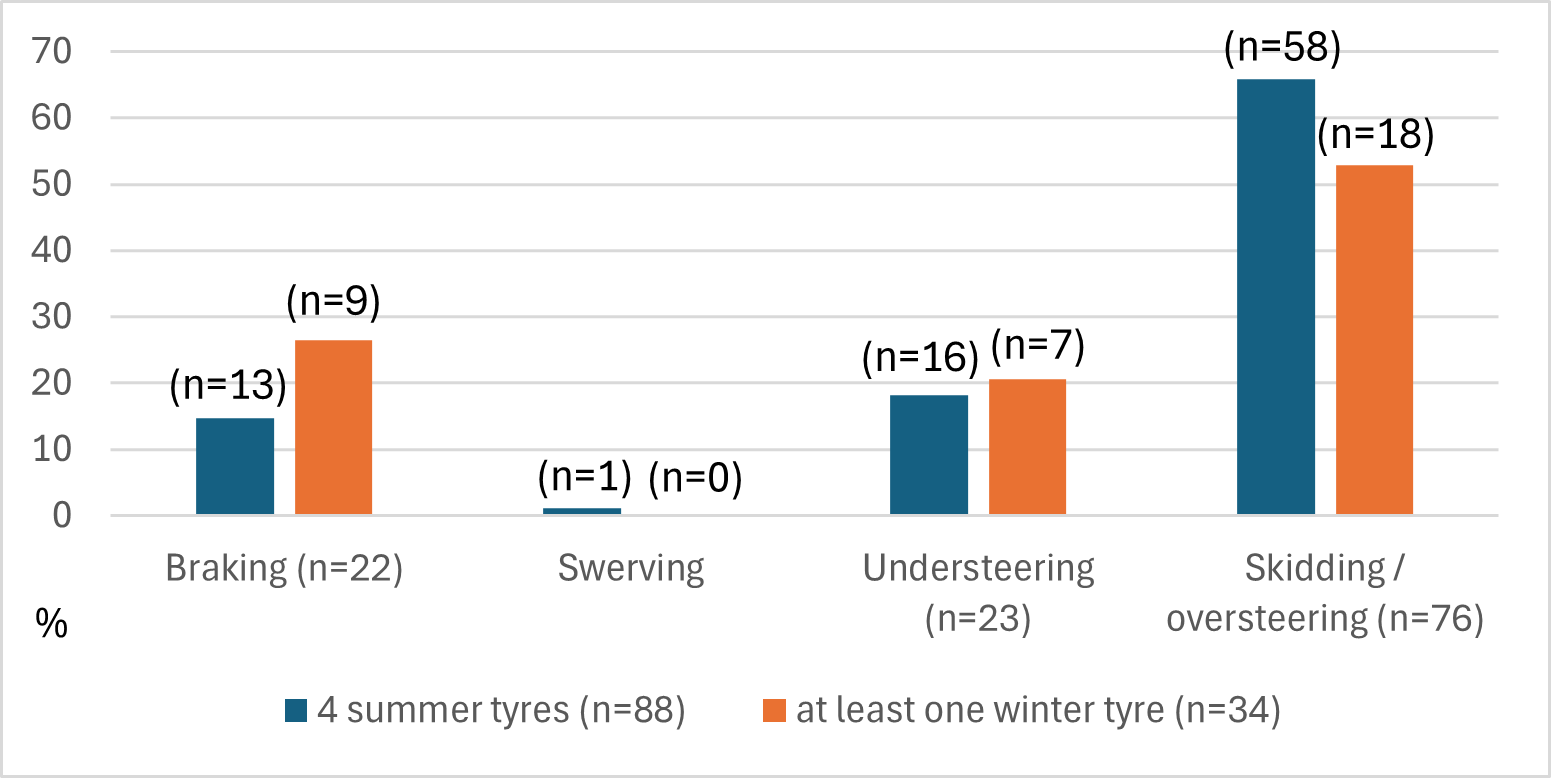
To gain insight into how the lower grip of winter tyres may lead to increased accident risk, the grip-related accidents were divided into four categories: braking, swerving, understeering and skidding/oversteering. A braking accident typically involves a straight braking event where the car tries to avoid or mitigate a collision with another traffic element or fixed object, or tries to stop before an intersection. Swerving is here defined as a sudden avoidance manoeuvre by steering, while the typical understeering accident is a single accident where the driver fails to negotiate a curve due to insufficient grip in relation to the speed, and drives off the road. In a skidding/oversteering accident the driver loses control of the car’s direction, leading to excessive yaw rotation (spinning around the vertical axle) or a slalom-like trajectory.
The differences between the tyre types are illustrated in Figure 3. While skidding/oversteering is the dominant accident category for both summer and winter tyres, braking accidents account for a larger proportion of accidents for cars with winter tyres than for those with summer tyres. This is despite cars with summer tyres to a larger extent being equipped with ESC, which is expected to reduce their share of skidding/oversteering and to some extent also understeering accidents.
The predominant road condition for the grip-related accidents was dry roadway (88%), with wet roadway accounting for 12%. Compared to non-grip-related accidents (90% dry and 10% wet), there is a slight increase in the percentage of accidents occurring in wet conditions. For cars equipped with at least one winter tyre, 9% of the grip-related accidents occurred on wet roadway, while the corresponding number for cars equipped with summer tyres was 14%.
3.2 Cars equipped with four winter tyres
The analysis has so far focused on cars equipped with at least one winter tyre, which includes at least 24 accidents with cars having a mixture of summer and winter tyres. It is plausible that combining tyres with large differences in grip would lead to reduced vehicle stability and therefore more accident-prone vehicles. Thus, it is important to also evaluate the possible risk increase for the subset of cars equipped with four winter tyres. The results are presented in Table 5, with a stratified analysis for confounding factors in Table 6.
| Classification groups | Winter tyres | Summer tyres | Effect and confidence interval | ||||
|---|---|---|---|---|---|---|---|
| Grip-related accidents | Non-grip-related accidents | Grip-related accidents | Non-grip-related accidents | R | E (%) | CI (%) | |
| 1 vs 4 | 25 | 20 | 88 | 112 | 1.59 | 59 | (-17 to 205) |
| (1+2) vs (3+4) | 42 | 40 | 160 | 214 | 1.40 | 40 | (-13 to 127) |
| Winter tyres | Summer tyres | Effect and confidence interval | ||||||
|---|---|---|---|---|---|---|---|---|
| ESC system | Yes | 11 | 10 | 45 | 81 | 1.98 | 98 | (-22 to 402) |
| No | 14 | 10 | 38 | 28 | 1.03 | 3 | (-60 to 166) | |
| Speed | Within regulated | 7 | 15 | 10 | 96 | 4.48 | 348 | (48 to 1258) |
| Above regulated (<30 km/h) | 10 | <5 | 24 | 9 | - | - | - | |
| Above regulated (≥30 km/h) | 8 | <5 | 46 | <5 | - | - | - | |
| Vehicle age | 0 – 10 years | 8 | 7 | 26 | 68 | 2.98 | 198 | (-2 to 807) |
| > 10 years | 17 | 13 | 62 | 43 | 0.91 | -9 | (-60 to 106) | |
| Intoxicated driver | Yes | 9 | < 5 | 40 | < 5 | - | - | - |
| No | 15 | 17 | 44 | 100 | 2.01 | 101 | (-9 to 337) | |
The relative risk increase of using four winter tyres during summer was found to be 59% when comparing group 1 and 4. Due to the relatively low number of accidents, the confidence interval is large (-17% to 205%), making the result not statistically significant. The effect is not overly sensitive to how accidents were classified as either group 1 or 2, as seen by calculating the odds ratio using the combined groups of (1+2) with (3+4). This leads to a relative risk increase of 40%, but although the confidence interval is smaller, the result is still not statistically significant.
A stratified analysis with respect to possible confounding factors leads to similar results as for the analysis of cars with at least one winter tyre (see Table 6). For cars with ESC system the relative risk increase of using four winter tyres is 98% (not statistically significant), for cars of 10 years or younger the risk increase is 198% (not statistically significant), and for non-intoxicated drivers the risk increase is 101% (not statistically significant). The largest risk increase was seen for accidents within the regulated speed, 348% (statistically significant).
Binary logistic regression analyses for both “at least one winter tyre” and “four winter tyres” gave similar results as those presented above.
3.3 Tyre types
There is no direct information in the in-depth studies on whether the studless winter tyres were made for Nordic or central European conditions. For accidents where detailed information of the tyre model exist it would be possible to manually determine this from case to case. However, with the available accident material such information was to a large extent lacking. Instead, the two types could be distinguished from the maximum speed label, where the tyres made for central European conditions are constructed for maximum speeds of 210 km/h and above, while those for Nordic conditions in general do not surpass 200 km/h. Speed labels were available for 75% of the studless winter tyres in the accident statistics. Out of these, 70% were tyres made for Nordic conditions, and 30% for central European conditions. The distribution of different types of winter tyres among the accidents with complete tyre information is listed in Table 7. While the subsets are too small for a meaningful risk analysis comparing the different winter tyre types, there is no indication that the Nordic winter tyres should be particularly prone to grip-related accidents. Instead, the central European tyres seem to be overrepresented among the grip-related accidents. However, since the data material is small, with a rather large share of tyres missing speed label information, it is difficult to draw any conclusions regarding the different types of winter tyres. This also applies to accidents with mixed summer and winter tyres, where the data material is even smaller.
| Four winter tyres | Mixed summer and winter tyres | |||||
|---|---|---|---|---|---|---|
| All accidents | Grip-related | Non-grip-related | All accidents | Grip-related | Non-grip-related | |
| Winter: Studless Nordic | 45% (147) | 40% (40) | 61% (49) | 16% (15) | 9% (3) | 25% (1) |
| Winter: Studless central European | 20% (67) | 32% (32) | 19% (15) | 8% (8) | 3% (1) | 0% (0) |
| Winter: Studless unknown | 20% (67) | 13% (13) | 10% (8) | 8% (8) | 9% (3) | 0% (0) |
| Winter: Studded | 14% (47) | 15% (15) | 10% (8) | 6% (6) | 16% (5) | 0% (0) |
| Summer | - | - | - | 61% (59) | 63% (20) | 75% (3) |
4. Discussion
During the period 2012–2021 the yearly number of fatal accidents involving at least one passenger car during the summer period May to September was just over 70. Out of these, 24% (or 17 accidents) involved a car where increased road grip most likely would have affected the outcome of the accident. Tyre information is lacking for almost one third of the in-depth studies of fatal accidents. The reason for this is not clear, but assuming that the missing data is not systematic with respect to tyre type it is estimated that about 12 of these grip-related accidents concern a passenger car equipped with summer tyres. Correspondingly, 3.5 of the yearly grip-related fatal accidents concern cars equipped with four winter tyres, and just over one such accident per year can be attributed to cars equipped with a mixture of summer and winter tyres.
4.1 Increased risk of using winter tyres during the summer period
Considering that the winter tyre use in Sweden during the summer period was estimated to be around 7% in 2020 (Grönvall, 2021), and most likely somewhat lower in the preceding years, cars equipped with at least one winter tyre are heavily overrepresented among the fatal accidents (22%). If only grip-related fatal accidents are considered, the share of cars equipped with at least one winter tyre increases to 28%. The induced exposure risk analysis comparing grip-related to non-grip-related accidents indicates a statistically significant increased fatal accident risk of for cars equipped with at least one winter tyre relative to summer tyres.
There are several possible confounding factors that may be associated with the observed risk increase:
-
ESC: Cars with at least one winter tyre are to a lesser extent equipped with an ESC system than cars with summer tyres, 42% compared to 67%. To investigate whether the general difference in ESC equipment is a confounding factor responsible for the risk increase, a stratified analysis with and without ESC was carried out. The results may be a bit surprising, where cars equipped with ESC suffer from an risk increase, although non-significant, when using at least one winter tyre, while for cars without ESC winter tyre use leads to no increased risk at all. A possible explanation for this will be discussed below.
-
Vehicle age: Cars equipped with at least one winter tyre were in general substantially older than those equipped with summer tyres, with an average vehicle age of 16 and 10 years respectively. However, limiting the risk analysis to cars with a maximum age of 10 years leads to a statistically significant increase in relative risk, rather than the opposite. For this subset of cars the influence from ESC can be disregarded as the difference in ESC share between the tyre types is marginal (95% with ESC for summer tyres, compared to 88% for cars with at least one winter tyre).
-
High speed: High speed is very common in fatal accidents, and among the grip-related accidents the share of accidents with a speed much above regulated (≥ 30 km/h) was larger for cars with summer tyres (58%) compared to cars with at least one winter tyre (38%). This does not necessarily indicate that drivers of cars with summer tyres have a higher tendency for speeding. It could also be a consequence of the superior grip of summer tyres, allowing driving at somewhat higher speeds before lack of grip becomes a safety issue, compared to winter tyres. Thus, summer tyres have a smaller proportion of grip-related accidents at lower speeds. The risk analysis carried out for cars where the speed has been assessed to be within the regulated speed limit indicates a statistically significant increased risk when using winter tyres. For cars with speeds above regulated limits, the number of non-grip-related accidents was too few to allow for a meaningful risk analysis.
-
Other: Possible confounding factors such as intoxicated driver and tyre tread depth, were also excluded as underlying explanations for the observed increased risk associated with driving with at least one winter tyre.
4.2 Possible explanation of the risk analysis results
As seen from grip tests, the winter tyres in summer conditions generally result in longer braking distances but also less responsive steering which, in turn, leads to increased understeering behaviour (Hjort et al., 2015). It has also been demonstrated in the literature that higher amount of oversteering during a manoeuvre can be achieved using tyres with good grip compared to poor grip (Kharrazi et al., 2014). A hypothesis conformant with the results of the risk analyses would be that the inferior grip of winter tyres leads to increased accident risk within regulated speed mainly due to increased braking distances, while at high speeds the accident risk for a non-ESC equipped car would actually be lower with winter tyres due to the increased understeering tendency. In contrast, a car equipped with summer tyres can be driven at higher speeds before losing control, and in absence of ESC can also achieve higher amount of oversteering, leading to more violent accidents. Thus, for cars without ESC the combined effect could lead to a zero net effect of winter tyres on all grip-related fatal accidents. For cars with ESC, the advantage related to oversteering at high speeds for the winter tyres is effectively reduced, leading to a total risk increase for all grip-related accidents.
It should be noted that the size of estimated risk increase is quite uncertain due to the rather small number of accidents, evident from the large confidence intervals. Therefore, absolute values of the risk increase should be used with caution. Still, the stratified analyses results in risk increases that are significant in all cases except for cars equipped with ESC.
Out of the cars equipped with at least one winter tyre, just over 20% had a mixture of winter and summer tyres. Summer tyres on the front axle combined with winter tyres on the rear axle leads to braking capabilities similar to exclusively using summer tyres, but results in an oversteered vehicle (see e.g. Hjort et al., 2015). Conversely, winter tyres on the front and summer tyres on the rear axle results in similar braking performance as having four winter tyres, but makes the vehicle increasingly understeered. Thus, it is plausible that mixing summer and winter tyres will affect the risk of a grip-related accident.
Limiting the analysis to cars equipped with four winter tyres resulted in an increased fatal grip-related accident risk in comparison with summer tyres. The effect is smaller than for cars with at least one winter tyre, but is still substantial, although not statistically significant. A stratified analysis investigating the effect of confounding factors leads to very similar effects as for cars with at least one winter tyre, although not statistically significant. The exception is for cars driving within the regulated speed, for which a statistically significant increased risk when using four winter tyres was found. Considering that about 30% of the grip-related fatal accidents for cars equipped with four winter tyres were caused by cars driving within the regulated speed, this increase of relative risk is not only of academic importance.
Considering that a quarter of the fatal accidents in Sweden during the summer period involved a car where increased road grip most likely would have affected the outcome of the accident, it is plausible that road grip has a large effect also on non-fatal accidents. Hence, the observed risk increase related to the use of winter tyres during the summer period will most likely have a negative impact on traffic safety that extends beyond the fatal accidents.
Winter tyres are widely used in many countries, including the Nordic countries, continental Europe, the United Kingdom, Canada, Japan, and Russia. If the prevalence of summer use of winter tyres in these countries is comparable to that observed in Sweden, the potential for improving road safety through a reduction in the use of winter tyres during summer conditions is considerable. Therefore, policy makers and other stakeholders need to address the findings in this study.
5. Conclusions
The performed risk analysis indicates clearly that the overrepresentation in fatal accidents of cars equipped with winter tyres in Sweden during the summer period to a substantial extent is related to the inferior road grip of winter tyres compared to summer tyres in summer conditions. The risk increase was particularly high for fatal grip related accidents when driving within the regulated speed limit. Considering that about 30% of the grip-related fatal accidents for cars equipped with four winter tyres were caused by cars driving within the regulated speed, this increase of relative risk is of concern.
Tyre properties have generally been neglected as a contributing factor among fatal accidents occurring in the summer period in the Swedish in-depth studies. That is evident from the fact that for 30% of the cars in those investigations, tyre information is lacking for all four wheels.
The present study shows that tyres have a substantial impact on grip-related fatal accidents with passenger cars in Sweden during the summer period, which account for 25% of the fatal accidents involving passenger cars. This highlights the need for increased attention to tyre properties in accident investigations. Especially since the tyre industry currently is facing increasing demands on environmental properties like low rolling resistance and high wear resistance, which most likely will have a negative impact on road grip.
CRediT contribution
Mattias Hjort: Conceptualization, Data curation, Funding acquisition, Investigation, Methodology, Writing – original draft. Linnea Kjeldgård: Data curation, Formal analysis, Investigation, Visualization, Writing – review & editing. Pontus Grönvall: Conceptualization, Data curation, Investigation, Project administration, Writing – review & editing. Anders Ydenius: Conceptualization, Data curation, Investigation, Writing – review & editing.
Acknowledgements
The authors want to thank Professor Claes Tingvall for fruitful discussions and valuable suggestions on how to analyse the data material. We also want to express our gratitude to Matteo Rizzi and Magnus Lindholm at the Swedish Transport Administration for supplying the accident data and discussing specific cases. Thanks also to Anders Kullgren, Folksam, and Christian Howard, VTI, for reading and commenting on the manuscript.
Declaration of competing interests
The authors report no competing interests.
Declaration of generative AI use
The authors declare that no generative AI was used in this work.
Prior dissemination declaration
This manuscript presents original work that has not been previously published or disseminated in any form.
Ethics statement
No external ethical evaluation of the research plan has been made. Such an evaluation was not considered necessary since the accident data used in the study was based on already carried out in-depth studies by the Swedish Traffic Administration. The data made available to us was totally stripped from any information that could identify involved people or vehicles. Nor was information on driver intoxication for separate accidents included in the material. Instead, driver intoxication data was supplied to us on an aggregated level. Furthermore, the involved researchers have signed a confidentiality agreement that prohibits any spread of individual information regarding the accidents.
Funding statement
This research was funded by Skyltfonden, the Swedish Transport Administration (grant TRV 2024/25073).
Editorial information
Handling editor: Marco Bassani, Polytechnic University of Turin, Italy.
Reviewers: Maria Rella Riccardi, University of Naples Federico II, Italy; Milan Tešić, Road Traffic Safety Agency, Serbia; Di Huang, Insurance Institute for Highway Safety/Highway Loss Data Institute (IIHS-HLDI), the United States of America.
Submitted: 27 February 2026; Accepted: 11 August 2026; Published: 21 August 2026.